Alum in Action: Amber N. Wiley's award-winning book offers insight on Race, Planning, and Education in the Nation’s Capital
|
Image
|
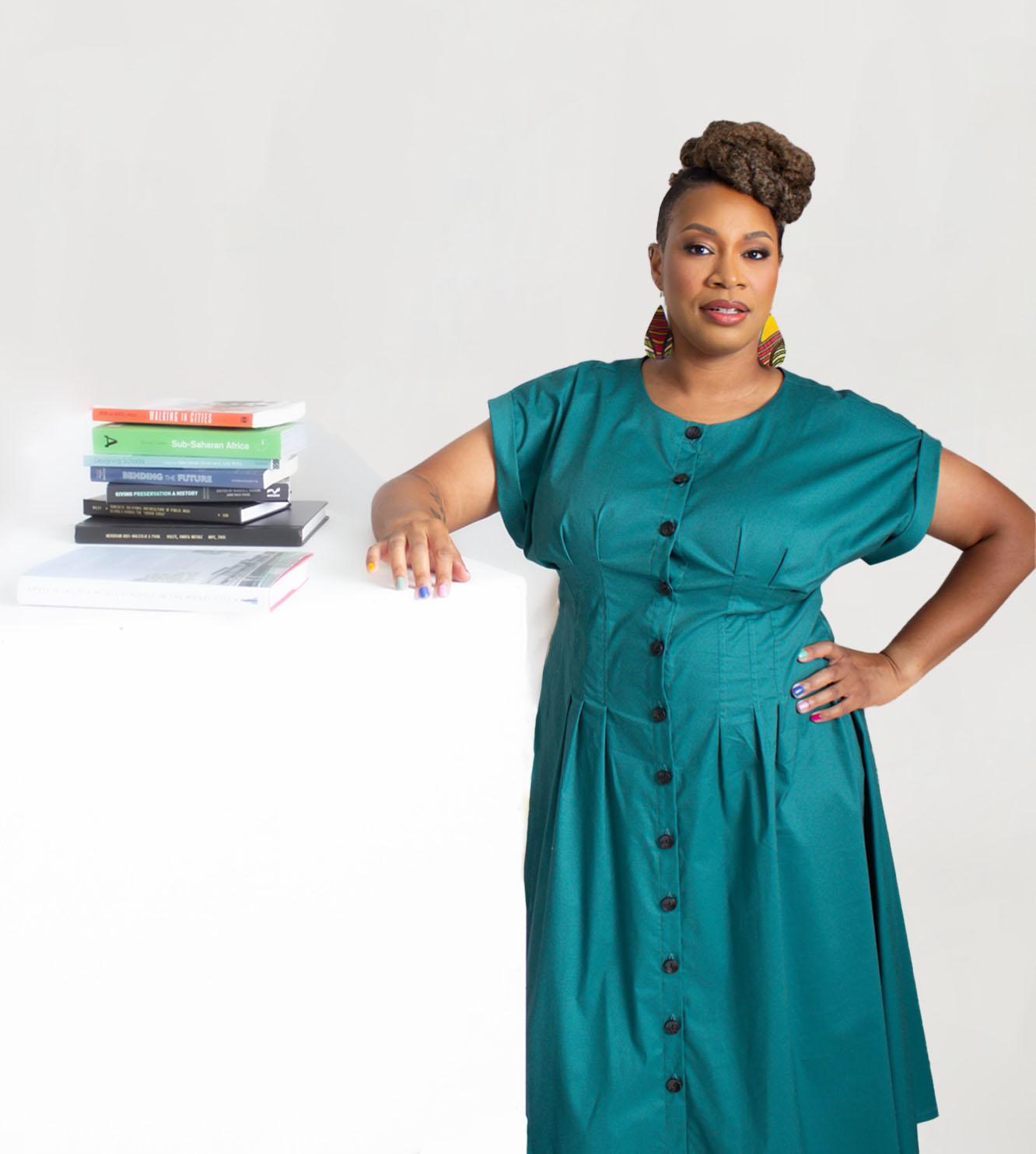
Amber N. Wiley, Ph.D. (MArH '05, with a certificate in Historic Preservation)
Wick Cary Professor and Director of the Institute for Quality Communities,
Christopher C. Gibbs College of Architecture, University of Oklahoma
Alumna and architectural historian Amber N. Wiley, Ph.D. (MArH '05), is the author of the acclaimed publication, Model Schools in the Model City: Race, Planning and Education in the Nation's Capital (University of Pittsburgh Press, 2026). The book, which recently was selected as the winner of the 2026 Joe William Trotter, Jr. Prize for Best First Book in Urban History by the Urban History Association, is described as a "sweeping, highly original, and lucid analysis of how school architecture reflects Black history, activism, and community formation in the nation's capital."
In her book, Wiley emphasizes the value of education as a means for social equality—Black Americans wanted the American Dream to apply to them, and equal opportunity for quality education was at the forefront of making that dream a reality. She expertly chronicles how Black Washingtonians used public education as a means of racial uplift in the face of entrenched white resistance and repeated assertions of white supremacy. Wiley argues that for Black Washingtonians, it was the school building—a permanent structure, made of sturdy material—that was the physical realization of Black liberation, agency, and the right to exist as citizens of the United States.
We asked Amber, who is the Wick Cary Professor and Director of the Institute for Quality Communities at the University of Oklahoma, to recount the genesis of her scholarship that led to the monograph and to reflect on how her time at the A-School at a graduate student in architectural history.
Image
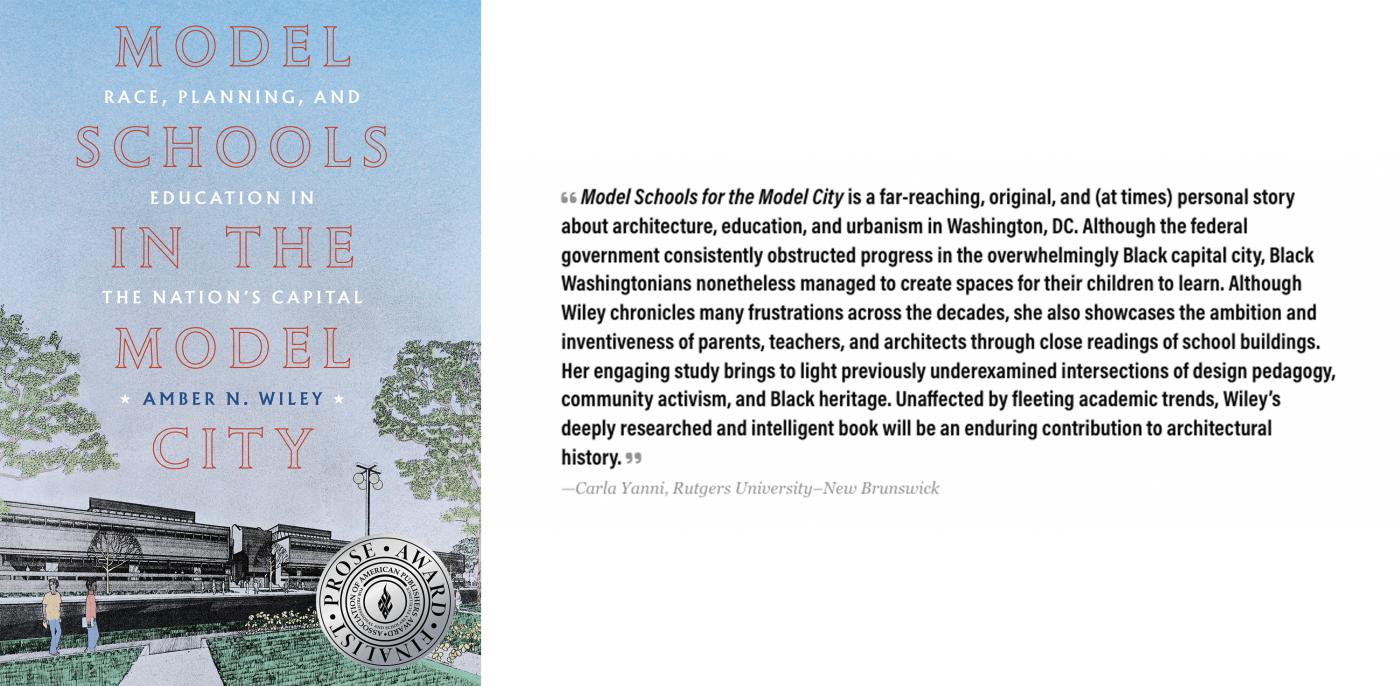
Model Schools starts with an Introduction titled “Finding My Roots” in which you describe the Paul Laurence Dunbar High School in Washington, DC, as “an institution of mythic proportions in my mind.” Can you share a little bit about how this school inspired the larger thesis of the book?
Paul Laurence Dunbar High School has long been considered the first public high school for Black students in the country, founded in 1870 as the Preparatory High School for Colored Youth (see Note below). Because of the school’s stature, which grew as it became known as the M Street School, and later, Dunbar High School, the list of administrators, faculty, and alumni is a veritable Who’s Who’s of Black American history. These are people who broke barriers in education, politics, law, the armed forces, science, the visual and performing arts, etc., like Nannie Helen Burroughs, Elizabeth Catlett, Anna Julia Cooper, Benjamin O. Davis Sr. Charles Drew, Charles Hamilton Houston, Hilyard Robinson, Carter G. Woodson.
I figured any place that had so many esteemed people walking through its doors had a weight of gravitas that I must experience firsthand. I see those figures as part of my historical genealogy, in a sense, because they paved the way for me as a Black American woman. Beyond that was the personal genealogy, since my great aunt Helen Plater had taught social studies at Dunbar, and my aunt Donna had attended Dunbar.
But the Dunbar I eventually visited was worlds away from the one in my imagination. When you imagine an institution with over 136 years of history (at the time that I started the research), you are expecting a certain type of edifice. What I saw when I visited – a 1970s Brutalist structure – was the opposite of what I envisioned.
It was the physicality of the building itself that prompted so many questions in my mind and started me down this path of researching school design for Black students in the nation’s capital.
Note from Amber:
The claim of “first public high school for Black students” is still disputed. Gaines High School in Cincinnati was founded in 1866 but closed around 1899.
_________
This book is the result of years of scholarship and research. What were some of the highlights along the journey of realizing this project?
The biggest highlight for me was finding a photograph of my Aunt Helen in the 1955 Dunbar yearbook. I was looking at that particular year to find any information about student reactions to the Supreme Court’s ruling on desegregation, and if that momentous case and its reverberations made its way into the pages of the yearbook. Then I found the image of my aunt. I knew no one else in my family had seen it before. I was so excited I wanted to share it with folks immediately, but I had to keep it to myself, so that it would be a surprise when the book was published and my family got to read it and hold it in their hands. It’s the very first illustration in the book. My Aunt Helen passed away when I was in high school, but I have very fond memories of her. I think she would appreciate how I laid out the story of the school that she poured her heart into through her dedication to education.
Another highlight is the Yale connection (see Note below). I was able to lead a group of Yale volunteers to help clean up the 1970s version of Dunbar High School for the DCPS Beautification Day, a back-to-school effort that the city ‘s school district used to host annually. We provided a service to the school, which in many ways felt like an homage. Some of Yale’s first Black graduates attended the M Street School and Dunbar, so it was a connection that came full circle.
A final highlight would be the relationships made along the way.
I have a network of archivists, alumni, activists, designers, historians, preservationists, community advocates, and memory workers in Washington DC and further afield who have consistently supported this work, chatted over coffee, pointed me in the right direction, showed up for my book talks, collaborated with me on other projects. It is a joy to share this journey with them.
Note:
Amber attended Yale University from 1999 - 2003, from where she received a B.A. in Architecture.
_________
You are currently the Wick Cary Director of the Institute for Quality Communities and an Associate Professor of Planning, Landscape Architecture, and Design in the Christopher C. Gibbs College of Architecture at the University of Oklahoma. What motivates you as an educator?
Curiosity is my biggest motivator. To understand, or at least know a little bit more about different people, places, cultures. While I am firmly rooted in investigations of the built environment, I can say my curiosity is also anthropological.
For me, the story never ends with the building, though it may begin there. It always ends with the people who endeavored to create the building, for their purposes, as a statement of their values and priorities.
I want my students to be able to see that story too. Moreover, I want them to go into the world in whatever sphere they may influence – architecture, planning, landscape architecture, environmental design, or something completely unrelated – and remember to center the people, with an understanding that for the built environment to function properly, those of us who shape it must put people before pride, ego, and the like.
Image
_________
What are a few things that you’ve taken with you into your career from your time as a Master of Architectural History student at UVA?
The root of my methodologies come directly from my time at UVA.
It was at UVA that I went from a novice architectural historian generally interested in preservation and planning to a skilled and battle tested researcher.
I use so many skills that I learned at UVA daily – Daniel Bluestone introduced me to Sanborn maps, city directories, census data, will and probate research. Louis Nelson taught me about dendrochronology, nail heads, and how to measure a building. Dell Upton pushed me to take my inquiries to the next level, to really think about the meaning behind our everyday surroundings and introduced me to theorists who I reference today. Ian Grandison allowed me to critically consider the role that race plays in how we experience the built environment. Craig Barton and Nisha Botchwey guided and mentored me as a budding young scholar. Lisa Reilly and Yunsheng Huang were ever protective of me and opened my eyes to the wonders of China when I participated in the study abroad program.
And the friendships I made – they are still extremely important in my work, but also in my life.
Jason Tippeconic Fox is working in the Oklahoma SHPO office right now and we are planning future collaborations. Elizabeth Milnarik, Nakita Reed, and I have worked together and supported each other extensively in Washington DC and in other locales. Jennifer Reut and I also work together on research and writing projects. Burak Erdim remains a constant conference buddy and someone to bounce ideas off of. Dan Williamson and I are contemplating future paper sessions together. Danielle Willkens and I have supported each other in lecturing and mentoring students. Then there are all the UVA grads I did not know during my time there, who have become a part of my extended personal and professional family— like Jillian Galle and the late Aaron Wunsch. I’m sure I left folks out and will later regret it. That is indicative of what it is like to have such an expansive UVA network.
More about Amber N. Wiley
Amber N. Wiley has dedicated her career to advancing the history and narrative of design and preservation in Black communities, as well as advocating for theoretically rigorous, thoughtful and inclusive expansions of preservation policy and practice. She has worked in cities across the United States, as well as internationally. She received her Ph.D. in American Studies from George Washington University. She also holds a Master’s in Architectural History and Certificate in Historic Preservation from the University of Virginia School of Architecture, and a B.A. in Architecture from Yale University. She is a native of Oklahoma City with roots in Washington, DC, Maryland, North Carolina, and Arkansas.
Her book, Model Schools in the Model City: Race, Planning and Education in the Nation's Capital, is Winner, 2026 Joe William Trotter, Jr. Prize for Best First Book in Urban History, Urban History Association; Finalist, 2026 Association for the Study of African American Life and History Book Prize; Finalist, 2026 Association of American Publishers PROSE Award in the Social Sciences; Shortlisted, 2026 Museum of African American History Stone Book Award; Honorable Mention Winner, 2026 Alison Isenberg Prize for Best Book on Urban Placemaking, Urban History Association.