
Joyce Fong
Landscape architecture is the creation of environmental data. In the context of climate urgency and ubiquitous computational intelligence, we need a paradigm shift in how we understand the agency of design. Our inherited methods, such as inventory, overlay, and suitability analysis, treat data as found condition: something surveyed, received, and responded to. This positions the designer as an interpreter of someone else's dataset, not a party accountable for how it came to exist. The research challenges the agency of landscape design and asks what landscape design becomes when designers take authorship of the data they design with.
Site analysis is the foundation of design propositions, yet conventional methods of landscape observation remain largely subjective and tied to a single spatial and temporal scale. This thesis expands site analysis through scientific methods for analyzing transcalar environmental patterns, with the goal of characterizing climate change impacts at scales relevant to design while preserving an understanding of ecosystem processes. Mapping is central to this work. It is not neutral registration of ground truth but an iterative design process that interprets, reveals, proposes, and negotiates between people and their environment. The contemporary design problem is not a choice between planetary-scale observation and ground-level specificity, but operating across them as a single computational-cartographic field. By calibrating observations from remote sensing, ground-based sensor networks, and in situ landscape embodiment, it redefines the three pillars of landscape design: site (defining the place), sight (methods of observation and sensing), and cite (representing the observed site for design propositions).
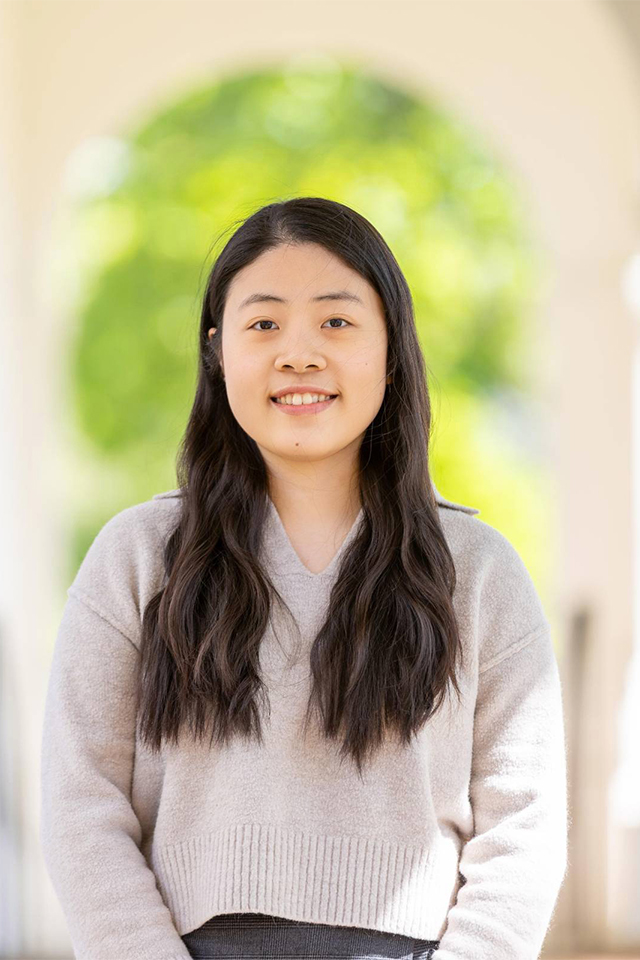
Joyce Fong is a Ph.D. student in the Constructed Environments. Graduated 2025 with a Master of Landscape Architecture from UVA, she sees herself as a “landscape translator” who bridges communities with their environment through culturally specific and climate-adaptive design. Joyce is interested in research on leveraging geospatial technologies and data-driven design strategies to address climate challenges. Joyce has a Bachelor of Arts in Landscape Studies from the University of Hong Kong. With her passion for synthetic design and landscape research in the context of climate change, she seeks opportunities to explore, experiment, invent, and implement meaningful tools for landscape architecture practices.
-
2026 UVA Society of Fellows Junior Fellow
-
2026 Council of Educators in Landscape Architecture Student Research Award
- 2025 Landscape Architecture Foundation Olmsted Scholar
- 2025 National ASLA Student Excellence Awards in Analysis and Planning Category on project – Stabilizing Thawing Ground: Meltwater Management in Utqiaġvik, Alaska (Team with Ari Bell and Shuai Yuan)
- 2024 Maryland ASLA Climate Action Plan Challenge Winning Team on project – Coastal Assemblages: Anchoring Memories and Materials in the City of Crisfield (Team with Julia MacNelly and Lysette Velázquez)
- 2024 LAF Honor Scholarship in Memory of Joe Lalli, FASLA
- 2023 Benjamin C. Howland Traveling Fellowship on project – A Dialogue with (Rain)water: Hong Kong (Team with Celina Qiu)
- 2023 WLA Student Award of Excellence in Concept Large Design Category on project – Re(de)fining Decomposition
- 2023 National ASLA Student Honor Awards in General Design Category on project – Re(de)fining Decomposition
- Fong, J, 2023. “Re(de)fining Decomposition: Entangling the Experiential Lens and Ecological Functions in the Deadwood Management Strategy. Landscape Architecture Frontiers, 1(11), 102-112.